Kentucky Star Motel
The Tiger RisingThe Kentucky Star Motel is the Florida lodging where Rob Horton and his father settle after leaving Jacksonville, six months after Rob’s mother dies. More than a temporary address, it is the fixed point around which Rob’s changed life takes shape: the place he waits for the school bus, returns to after finding the tiger, and moves through while trying to keep grief locked away. Its neon sign offers him a fragile token of good luck; its small, concrete rooms hold the less reassuring facts of loss, displacement, and daily life.
Setting and Appearance
The motel is an unassuming two-story building made of cement block. Its rooms are squat and small, their doors painted in different colors—pink, blue, or green—with a chair of the matching color set outside each door. Sistine Bailey notices the building when she visits Rob and asks why it is called the Kentucky Star. Rob offers only the shortest answer he can think of, leaving the name’s promise of brightness in contrast with the plain, practical structure before them.
The Kentucky Star’s sign is more vivid than the building itself: a yellow neon star rises and falls over blue neon shaped like the state of Kentucky. Rob likes watching it and holds a dim but abiding notion that it will bring him good luck. The sign’s rising and falling gives the motel a small, recurring image of ascent amid a life that has not yet recovered its footing; its hopeful glow belongs not to a grand escape but to the ordinary place where Rob waits and comes home.
A Temporary Home After Jacksonville
Rob and his father move from Jacksonville to Lister after the funeral, and the motel becomes their home during the six months in which Rob does not cry. When Sistine asks whether he lives there, Rob explains that it is not permanent and that they are staying until they get back on their feet. His answer frames the motel as provisional shelter rather than a chosen destination, while also revealing how much of the family’s future remains unsettled.
The move is part of a larger change Rob tries not to think about. He imagines his feelings packed into a suitcase, like the one he packed when he and his father left Jacksonville after the funeral: everything pushed inside, the case shut and sat upon. The motel is the place where this strategy continues. Its rooms provide a daily address, but they do not undo the loss or make the family’s displacement disappear; Rob keeps his grief contained while the neon star supplies a small counter-image of hope.
Rob’s Discovery and the Motel’s Surroundings
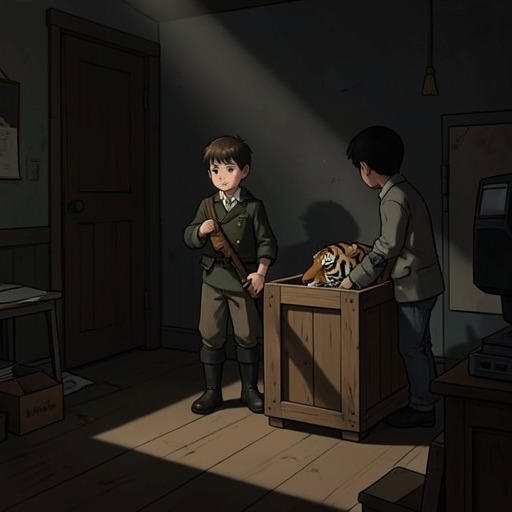
The motel’s location places it beside the woods where Rob discovers the caged tiger. On a gray, rainy morning, he wanders deep into the woods behind the Kentucky Star, hoping to get lost or be eaten by a bear rather than go to school. Near an abandoned, boarded-up gas station, he finds a large tiger pacing inside a cage. The sight is so astonishing that he fears looking too long in case the animal disappears; as he runs back toward the motel, his heart insists on what his mind doubts.
The next morning, Rob stands beneath the Kentucky Star sign and waits for the school bus as if it were an ordinary day. That routine follows directly upon the extraordinary discovery: the tiger has become something he carries back into the motel’s everyday orbit. Rob’s habit of not-thinking about what hurts has a new object to sit on top of his metaphorical suitcase. The motel thus links his hidden emotional life to the secret that will alter his days, without itself becoming the site of the tiger’s discovery.
Daily Life and Narrative Significance
The motel’s exterior walkways form part of Rob’s routine. He sweeps the cement walkway in front of the rooms when Beauchamp pulls up in a red jeep and calls to him. This brief encounter places the motel among the ordinary work and exchanges of Rob’s life, as well as among the settings through which the tiger’s secret enters his daily responsibilities.
In the story, the Kentucky Star is both a practical home and a visual counterpoint to Rob’s effort to suppress feeling. The colored doors and matching chairs give the building a distinct, modest character; the motel’s name and animated neon sign suggest brightness and ascent without erasing the hard facts of a temporary stay. Rob’s return to the sign after finding the tiger brings those meanings together: he resumes the school-day routine, but the discovery has given him something new to hold in mind. The motel remains the grounded place from which that private knowledge travels into the rest of his life.